
Amanda Bisk: Masters Pole Vault, Longevity and Life After Elite Sport
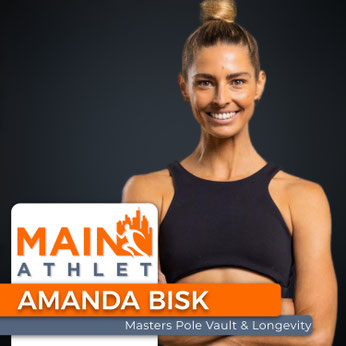
Amanda Bisk represented Australia at the 2010 Commonwealth Games in New Delhi – as a pole vaulter who had started as a gymnast, transitioned through high jump, and found her discipline almost by accident. A two-week trial at age 18 turned into a seven-year international career.
Then, in 2011, chronic fatigue syndrome ended everything. What followed was not just a recovery – it was a complete reinvention. Today, Amanda is back on the runway, jumping 3.85m in the W40 category and preparing for the World Masters Championships in Daegu. She also runs a fitness app followed by over 600,000 people on Instagram.
This episode of the MainAthlet International Podcast traces every step of that journey – from Perth to New Delhi, from burnout to business, from retirement to Masters athletics.
From Gymnastics to Commonwealth Games – Amanda's Athletic Career
Amanda Bisk grew up in Perth, Western Australia, born to Polish parents who brought with them a European sensibility, loud dinner parties and strong cooking. Sport was always present. She entered the gymnastics system at age three and was training at the state institute level by six. When she grew too tall for the conventional gymnastics path, she transitioned into athletics – first high jump, then pole vault. Her high jump personal best of 1.75m was enough to compete at national championships, but it was the pole vault that captured her completely. The technical complexity, combined with the athleticism of gymnastics and the open-endedness of athletics, made it the ideal match. A two-week trial with the pole vault squad at age 18 – granted reluctantly by a coach who thought she was too old to start – turned into a place on the squad. By 2009 she was wearing the Australian uniform for the first time, at the World University Games in Belgrade. A year later came the Commonwealth Games in New Delhi.
Chronic Fatigue, Identity Loss and the Forced Pivot
In 2011, a few months after the Commonwealth Games, Amanda was diagnosed with chronic fatigue syndrome. For an athlete whose entire identity was built around competition, training and performance, the diagnosis was more than a health setback – it was the end of a self-concept. She stepped away from pole vault not knowing it was permanent. The road back to health was long and took her through yoga, meditation and a complete reassessment of what movement meant to her. That process became the foundation of her business. What started as sharing yoga poses on a newly discovered platform called Instagram grew, over more than a decade, into a fully developed fitness app, multiple coaching qualifications – yoga, Pilates, personal training, CrossFit, athletics – and an audience of over 600,000 followers. The illness that ended her athletic career became the starting point for everything that followed.
Masters Athletics and the Return to Competition
Amanda turned 40 in 2026 and moved into the W40 category – and for any masters athlete, that birthday is less a milestone than a reset. New age group, new goals, new energy. Her current season best of 3.85m in pole vault is among the top performances in the W40 category globally, and a personal target of clearing four meters again is firmly on the horizon. She is planning to compete at the World Masters Championships in Daegu – a stadium she actually competed in fifteen years earlier, as an elite athlete. The symmetry is not lost on her. The episode explores what it means to return to a sport after a decade away, how masters athletics differs from the elite environment – and why, according to Amanda, it is in many ways better.
Longevity, Movement and Coaching Philosophy
The concept that connects all phases of Amanda's career is movement – and a growing focus on what it means to move well, pain-free and sustainably into later life. Her app now includes a dedicated body care section focused on foundational strength, mobility and longevity, sitting alongside yoga, Pilates and dumbbell programs. Her coaching philosophy applies equally to elite athletes and everyday people: be there for the person, not just the performance. In the episode, she talks about how coaching masters athletes is uniquely satisfying precisely because her athletes are adults who know what they want – and still need every bit of support, technique and presence that elite coaching demands.
